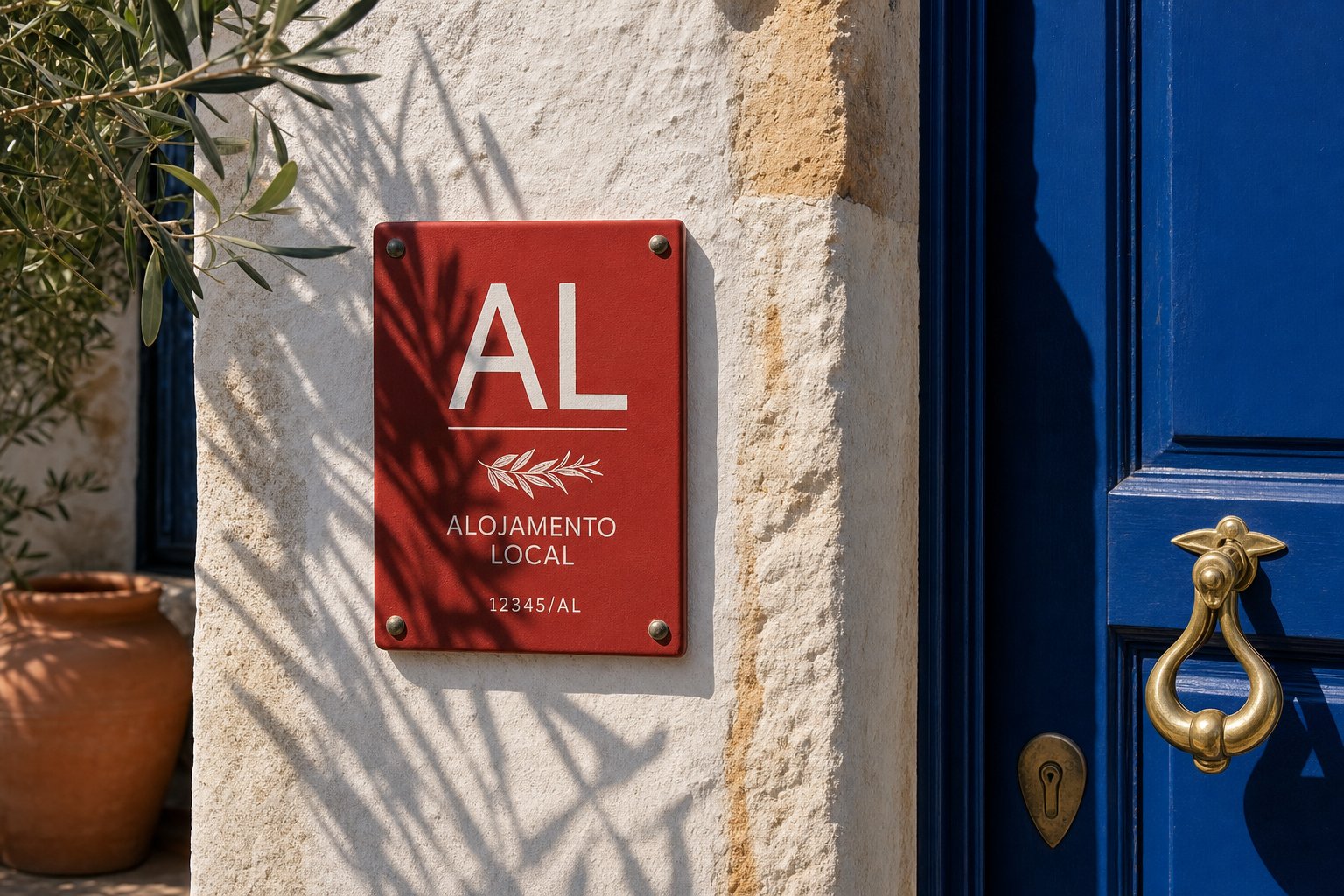
Every Algarve villa rented to short-term guests is, in law, an alojamento local. The framework governing that designation — who can operate one, on what terms, under what obligations — is set out across Decreto-Lei n.º 128/2014 as amended, Decreto-Lei n.º 76/2024, and a body of secondary legislation that most British owners have never read, because it has never been translated for them. This article addresses that gap. What follows are the Alojamento Local requirements in English, organised by category, accurate as of 16 May 2026.
This is not a summary. It is a reference. Bookmark it, share it with your property manager, and consult it before your next inspection — or before a município official asks to see your paperwork.
Registration: how to legalise an Alojamento Local
The first step in every AL journey is a comunicação prévia — a prior communication submitted through ePortugal's Balcão do Empreendedor. This is the portal through which you notify the state of your intention to operate, providing proof of property ownership (or authorised use), identification documents, and the property's fiscal registration number. No in-person visit is required.
Once the comunicação prévia is processed, you are assigned an RNAL number — Registo Nacional dos Alojamentos Locais — in the format XXXXX/AL. This number is not optional decoration. It must appear on every listing: Airbnb, Booking.com, your own website, and any printed collateral. Operating without it exposes individual owners to fines of €2,500 to €4,000; for corporate operators, that range rises to €25,000 to €40,000.
Alongside the RNAL number, you are required to display an AL plaque at the property entrance. The plaque's design and specifications are set out in Portaria 262/2020. There is no grace period: if the plaque is missing when an ASAE inspector visits, the fine clock starts immediately.
For a detailed account of what changed in the most recent legislative overhaul, see our guide to DL 76/2024.
Property standards
Portuguese law specifies minimum habitability conditions for every AL property. These are not aspirational — they are the baseline below which you cannot legally operate. The property must have:
- Hot and cold running water, with connection to the mains sewage system or an approved alternative
- Adequate natural ventilation and natural light in all habitable rooms
- External light-blocking in all sleeping areas (blackout blinds or equivalent)
- A secure entry door with functioning locks, and individual locks for each bedroom
- Heating and cooling appropriate to the Algarve climate — air conditioning units in guest-accessible rooms are now standard practice rather than a luxury
On capacity: the maximum permitted is nine bedrooms and 27 guests, following the reduction from 30 introduced by DL 76/2024. Convertible beds (sofas, fold-outs) are permitted, but may not exceed 50% of the count of fixed beds.
Alojamento Local requirements English: safety
The safety requirements for an AL property are specific and inspectable. Every AL must have the following on-site at all times:
- A certified fire extinguisher, serviced annually and bearing a current inspection tag
- A fire blanket, positioned in or immediately adjacent to the kitchen
- A CE-marked first aid kit, accessible to guests
- The emergency number 112 displayed in a prominent location — typically on the information board
Properties with capacity for 10 or more guests face additional obligations: evacuation plans must be prepared and posted, and fire detection systems must be installed. If your villa has more than nine guests, this is not optional.
The gap between what most Algarve villas actually have and what the law requires is not ignorance — it is information never delivered in English.
Ongoing certificates and insurance
Registration is a one-time event. Compliance is a recurring calendar. Every AL owner must maintain the following live documents:
- Gas safety inspection — required every two years for any property connected to mains gas or with gas appliances. The certificate (Certificado de Segurança de Gás) must be issued by an ERSE-registered technician.
- Electrical safety certificate (Certificado de Segurança Elétrica) — required every three years. Covers the installation and consumer unit.
- Energy Performance Certificate (Certificado Energético, issued by ADENE) — valid for ten years. Must be displayed in listings.
- Civil liability insurance — mandatory since 2021, with a minimum cover of €75,000 per incident. If a município requests proof of insurance, you have three working days to produce it. Failure to comply is a separate infraction.
For a full map of renewal dates and the consequences of letting certificates lapse, see our article on Portugal rental property compliance for UK owners.
Guest registration: AIMA and the SIBA system
Every foreign guest staying at an AL property must be registered with AIMA (the immigration and borders authority) via the SIBA platform. Registration must be completed within three working days of arrival. The information required includes passport details, nationality, date of arrival, and planned departure date.
This is not the same as check-in. It is a separate legal obligation, distinct from any record kept by Airbnb or Booking.com. Their guest data does not satisfy the AIMA requirement.
The fine for each unregistered foreign guest is €100 to €2,000. For a busy villa receiving 40 or 50 guests per season, the cumulative exposure from non-compliance is substantial.
Complaints book and guest information
Two documentation requirements catch many owners by surprise, because they appear administrative rather than safety-related — but both are actively enforced by ASAE.
First, the Livro de Reclamações (complaints book): every AL must have both a physical complaints book and be registered on ASAE's digital complaints platform. The physical book must be made available to guests on request. Failure to maintain either version is a sanctionable infraction.
Second, an information book must be provided to guests on arrival. It must be multilingual — Portuguese, English, and at least two further languages — and must cover: house rules, appliance operating instructions, waste management and recycling procedures, and emergency contacts including the local authority and nearest hospital.
Condominium rules after DL 76/2024
One of the most discussed changes introduced by DL 76/2024 concerns AL properties within apartment buildings and condominiums. Under the previous regime, neighbours could effectively block a licence through the condominium assembly. That requirement has been removed.
However, a new mechanism exists: if a condominium assembly votes by a majority of more than 50% and presents documented evidence of repeated disturbances attributable to the AL, it may petition the município to review the licence. The município retains the final decision. This is not an automatic revocation — but it is a real risk for operators who manage their properties poorly and generate complaints from neighbours.
What to do next
If you own an Algarve villa and are unsure whether it meets every requirement listed here, the most practical step is a structured compliance audit against each category above: registration documents, safety equipment, current certificates, insurance, AIMA registration process, and guest documentation. The Turismo de Portugal website provides the regulatory reference; the ePortugal portal handles the inicial registration. For British owners who would rather have every obligation managed and reported back in English, APC handles the full compliance stack — from first registration through to annual certificate renewals and guest registration.